
- by Pepper Developments
The Science of Feather Structure: Why Ostrich Feathers Float, Flex, and Flow
- by Pepper Developments
Feathers are among the most sophisticated natural materials on Earth. Lightweight yet strong, flexible yet resilient, they perform functions that range from flight and insulation to communication and protection. While most people associate feathers with birds soaring through the sky, not all feathers are designed for flight. Ostrich feathers, in particular, behave in ways that feel almost magical: they float effortlessly in air, bend and recover without breaking, and flow smoothly with the slightest movement.
Understanding why this happens requires going beyond surface-level descriptions and diving into the biological and structural science of feathers themselves. At a microscopic level, feathers are complex keratin-based systems engineered by evolution to balance strength, elasticity, and minimal weight. Ostrich feathers highlight this balance especially well because, unlike flight feathers, they are optimized for flexibility, airflow interaction, and thermal regulation rather than lift.
In this article, we explore the science behind feather structure with a specific focus on ostrich feathers. We examine their anatomy, material composition, mechanical behavior, and functional advantages, while also drawing insights from biomechanics and materials science. By the end, you will understand why ostrich feathers float, flex, and flow so differently—and why they continue to inspire applications in design, fashion, and biomimetic engineering, including refined feather craftsmanship seen in collections such as those by Fancy Feather.
At its core, a feather is a highly specialized skin appendage made primarily of keratin, the same structural protein found in hair, claws, and horns. Unlike hair, however, feathers branch into intricate hierarchical structures that allow them to perform multiple functions simultaneously.
A typical feather consists of a central shaft known as the rachis, which extends from the base (calamus) outward. From this shaft branch hundreds of barbs, and from each barb extend microscopic barbules. In many feathers, especially flight feathers, these barbules interlock through tiny hook-like structures, creating a smooth, continuous surface.
This architecture is not accidental. According to research summarized by Encyclopaedia Britannica, feathers evolved to maximize surface area while minimizing mass, allowing birds to interact efficiently with air and temperature.
Birds possess several feather types, including contour feathers for shape, down feathers for insulation, and flight feathers for aerodynamics. Ostrich feathers fall primarily into the contour and display category. They lack the tight interlocking structure of flight feathers, which immediately explains why they behave so differently in air.
From an evolutionary standpoint, feathers first appeared not for flight, but for insulation and display. Fossil evidence shows that feather-like structures existed in dinosaurs long before powered flight evolved, reinforcing the idea that feathers are multifunctional biological tools rather than flight-only components.
Ostrich feathers are structurally distinct even when compared to other non-flying birds. Their design reflects millions of years of adaptation to a terrestrial lifestyle in open, often extreme environments.
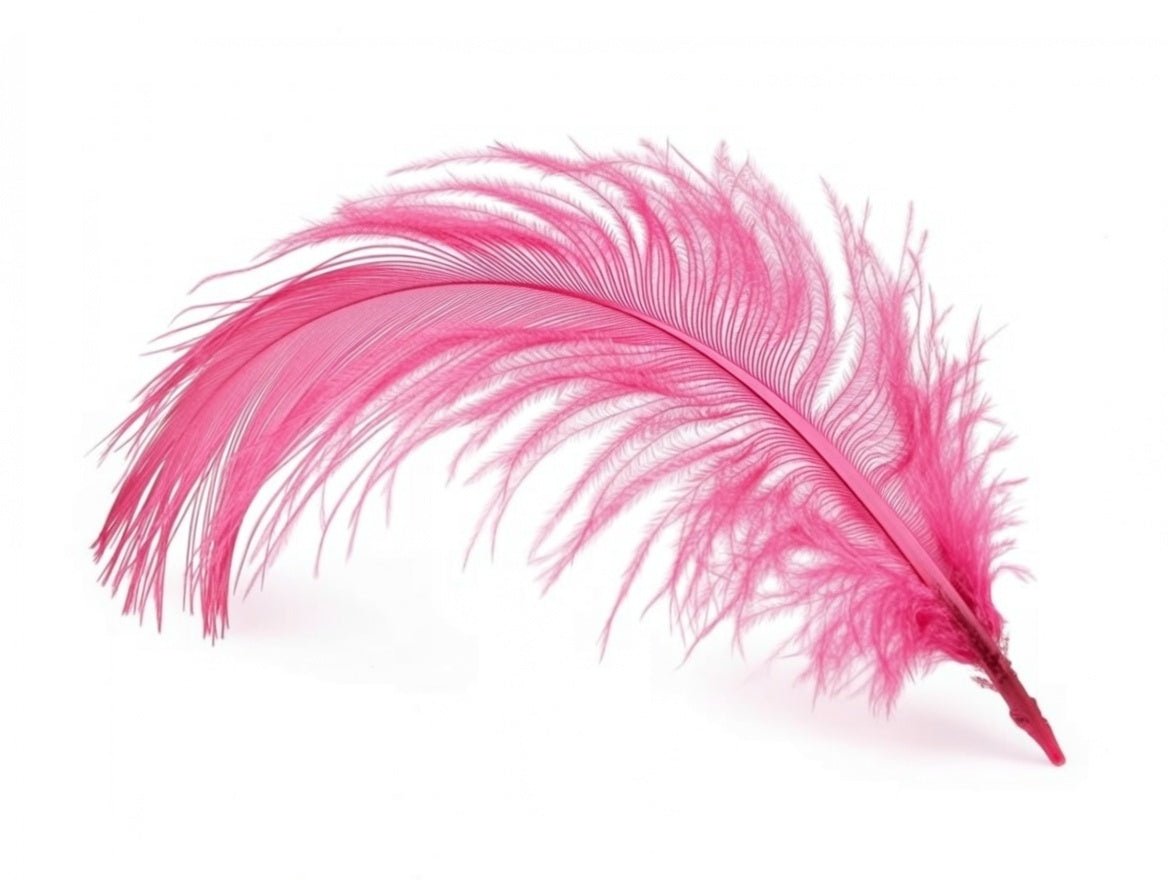
Unlike flight feathers, ostrich feathers have barbules that do not hook together. This results in an open, plume-like structure that feels soft and airy. Air passes easily through the feather, allowing it to move fluidly rather than resist airflow.
This loose architecture explains why ostrich feathers appear to “flow” rather than hold a rigid shape. When exposed to wind or movement, each barb responds independently, creating a wave-like motion that is both visually striking and mechanically efficient.
Because ostriches do not fly, their feathers do not need to generate lift or withstand high aerodynamic forces. Instead, their structure prioritizes flexibility, insulation, and visual display. Studies in avian morphology show that this relaxed feather architecture reduces mechanical stress on the shaft and prevents breakage during rapid running or aggressive environmental exposure such as sand and heat.
This is one reason ostrich feathers have long been valued in high-end decorative and functional applications, where softness and movement are prized.
The true marvel of feathers lies not only in their shape but in their material composition. Keratin is a fibrous protein with exceptional mechanical properties, and feathers use it with remarkable efficiency.
Feather keratin forms a composite structure, combining stiffness and flexibility in different regions of the feather. The rachis contains densely packed keratin fibers aligned along the length of the shaft, providing strength. The barbs and barbules contain less dense keratin arrangements, allowing for flexibility and resilience.
Research in biological materials science, including studies referenced by National Geographic, highlights that feather keratin rivals synthetic composites in strength-to-weight ratio.
At the microscopic level, keratin fibers are embedded in a protein matrix, forming a natural composite similar in concept to carbon fiber materials. This structure allows feathers to bend under stress and return to their original shape without permanent deformation.
For ostrich feathers, this means exceptional durability despite their delicate appearance. Practical takeaway: when handling or cleaning ostrich feathers, gentle movement preserves their structure because they are designed to flex, not resist force.
Flexibility is one of the defining features of ostrich feathers, and it is deeply rooted in their mechanical design.
Feather shafts are not uniform rods. Their cross-sectional geometry changes along their length, allowing controlled bending. In flying birds, this bending helps manage aerodynamic loads. In ostriches, it serves a different function: absorbing mechanical shocks from movement and environmental contact.
Biomechanical studies show that feather stiffness is governed more by geometry than material alone. Ostrich feathers, with their thinner rachis and open vane structure, naturally favor flexibility over rigidity.
When an ostrich feather bends, energy is temporarily stored in the keratin fibers and released as the feather returns to its resting position. This elastic behavior prevents cracking and prolongs the feather’s lifespan.
For designers and artisans, this property means ostrich feathers maintain their form even with repeated motion, making them ideal for applications where movement and longevity matter.
One of the most captivating qualities of ostrich feathers is their ability to float and drift in air rather than fall quickly.
Floating is not about buoyancy in the traditional sense but about drag. Ostrich feathers have a very high surface-area-to-mass ratio. Their open structure increases air resistance dramatically, slowing their descent.
As air moves through the feather, it becomes trapped between barbs, creating localized turbulence. This turbulence increases drag and produces the characteristic slow, graceful fall.
Because their barbs move independently, ostrich feathers constantly change shape as they fall. This dynamic reshaping prevents a stable downward path and creates the illusion of hovering.
Practical insight: when displaying ostrich feathers decoratively, allowing airflow around them enhances their natural movement and visual appeal.
Comparing ostrich feathers to flight feathers highlights just how specialized feather structures can be.
Flight feathers are asymmetrical, with tightly interlocked barbules forming a rigid vane. This structure creates lift and minimizes turbulence, allowing birds to control airflow precisely during flight.
The shafts of flight feathers are reinforced to withstand significant bending forces, and their surface acts like a flexible airfoil.
Ostrich feathers are symmetrical and lack interlocking barbules. Instead of slicing through air, they interact with it. This makes them unsuitable for flight but ideal for flow, insulation, and display.
This distinction reinforces a key principle of biology: structure always follows function.
Despite their loose structure, ostrich feathers play a critical role in temperature regulation.
The open architecture of ostrich feathers traps layers of still air close to the skin. Air is an excellent insulator, and this trapped layer reduces heat transfer.
In hot environments, feathers can also shade the skin while allowing heat to escape through convection. This dual role is especially important in the extreme temperature swings of the African savannah.
Ostriches adjust feather positioning to regulate body temperature, fluffing feathers in cold conditions and flattening them in heat. This behavior-driven insulation is a direct result of feather flexibility.
Feathers are communication tools as much as physical structures.
Ostrich feathers are used extensively in mating displays and social signaling. Their movement amplifies visual cues, making displays more noticeable from a distance.
Feathers also protect skin from ultraviolet radiation and abrasions. Their sensitivity allows birds to detect subtle changes in airflow, enhancing environmental awareness.
This multifunctionality explains why feather structure remains conserved across species, even when flight is lost.
Scientists and engineers increasingly look to feathers for inspiration.
Feathers demonstrate how to achieve maximum performance with minimal material. Their hierarchical structure informs the design of lightweight composites and flexible surfaces.
Research in biomimicry explores how feather flexibility can inspire adaptive materials that respond dynamically to airflow. Ostrich feathers, in particular, offer insights into passive flow modulation.
For creators working with feathers, respecting this natural design—rather than forcing rigidity—leads to better durability and aesthetics, a principle reflected in refined feather craftsmanship such as that seen at Fancy Feather.
Despite their familiarity, feathers are often misunderstood.
While some shafts contain air pockets, feathers are not hollow tubes. They are complex, foam-like composites optimized for strength and weight reduction.
Ostrich feathers clearly demonstrate that flight is only one of many feather functions. Assuming all feathers should behave aerodynamically ignores the diversity of feather evolution.
Understanding these distinctions allows for more informed use and appreciation of feathers in both scientific and creative contexts.
Feathers are masterpieces of natural engineering, combining intricate structure with remarkable material efficiency. Ostrich feathers, in particular, reveal how evolution can adapt a common biological blueprint to entirely different functional demands. Their ability to float, flex, and flow is not accidental but the direct result of loose barb architecture, keratin-based composite materials, and geometry optimized for airflow interaction rather than lift.
By examining feather structure through the lenses of biology, mechanics, and materials science, we gain a deeper appreciation for why these natural forms behave as they do. This understanding not only enriches our knowledge of the natural world but also informs better design, handling, and application of feathers in modern contexts.
As science continues to uncover the secrets embedded in feather microstructure, ostrich feathers remain a powerful reminder that softness and strength, flexibility and durability, can coexist when structure truly follows function.
Share:
Feather Boas in Music Videos: Iconic Moments from the MTV Era to TikTok
Feather Boas in Film Noir and Classic Hollywood: Behind-the-Scenes Costume Stories